
A personal proposal · Illinois Supreme Court Rule 703
One word in Rule 703.
Why the details matter.
Stephen Murphy · Proposal dated February 13, 2026
My daughters and I wrote a proposal to make the language of Illinois Supreme Court Rule 703 gender neutral. The request was small: replace “he” with “the applicant.”
On April 1, 2026, the Illinois Supreme Court entered an order making that wording change, effective immediately. Below are our redacted letters and the official order, so you can read the proposal and the amendment for yourself.
- Our proposal and cover letters.
- The Court’s amendment order, effective immediately.
The wording we proposed
The sentence already begins with Each applicant. Our proposal replaces the later “he” with the applicant. The Court’s April 1 order uses that same replacement.
The relevant change in the April 1 order
Each applicant shall make proof that he the applicant has completed such law study and received a degree …
Excerpt from the official amendment order, M.R. 3140. The order establishes the amendment and its effective date; it does not identify the proponents. The letters below document our dated proposal.
A family contribution
The proposal carries all three signatures. My daughters’ given names are redacted; their surname, Murphy, remains.
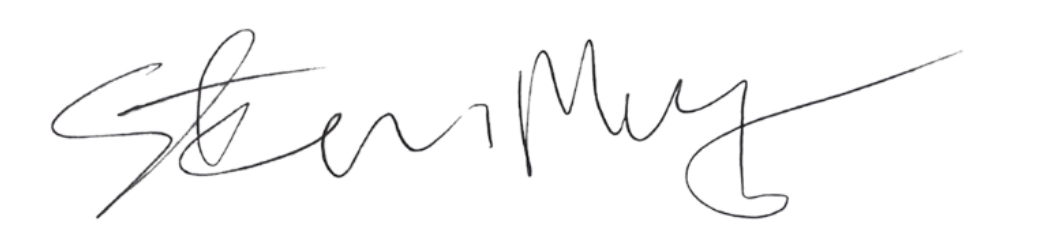


Cropped from the redacted signed proposal. Black rectangles mark information removed from this public copy.
Our proposal to the Rules Committee
Readable redacted transcription of the five-page signed packet. The original date, recipient information, proposed wording, and rationale are preserved. Redacted names and personal contact details appear as black rectangles. Signatures are reproduced separately above and in the PDF.
Original page 1
Stephen Murphy
[REDACTED]
[REDACTED]
[REDACTED]
[REDACTED]
February 13, 2026
Committee Secretary
Supreme Court Rules Committee
222 N. LaSalle Street, 13th Floor
Chicago, IL 60601
CC: Board of Admissions to the Bar, 625 S. College St., Springfield, IL 62704
Re: Proposal to Amend Supreme Court Rule 703 — Gender-Neutral Language
Dear Secretary of the Rules Committee:
Enclosed please find a Proposal to Amend Illinois Supreme Court Rule 703, submitted pursuant to Rule 3 for the Committee’s consideration.
The proposal addresses a single gendered pronoun (“he”) that was carried forward during the May 29, 2025 amendment of Rule 703 (M.R. 3140, Proposal 24-15). The proposed fix is minimal: replace “he” with “the applicant.” The change is consistent with the gender-neutral drafting used elsewhere in the rule and does not alter any substantive requirement.
I am not a lawyer. I am a pro se litigant and a father of two daughters who noticed this while reading the rules for my own cases. One of my daughters has expressed an aspiration to become a lawyer. I would like the rules she reads someday to include her in their plain language — not because a construction statute says 'he' technically means everyone.
Original page 2
I respectfully request that the Committee assign this proposal a docket number and place it on the agenda for a future public hearing. I would welcome the opportunity to present brief testimony at such a hearing. A courtesy copy of this proposal has been sent to the Board of Admissions to the Bar.
Thank you for your time and attention.
Respectfully,
Stephen Murphy
On behalf of himself, [REDACTED] Murphy, and [REDACTED] Murphy
Enc: Proposal to Amend Supreme Court Rule 703
Original page 3
PROPOSAL TO AMEND
SUPREME COURT RULE 703
Submitted pursuant to Illinois Supreme Court Rule 3
EXECUTIVE SUMMARY
This proposal requests that the Illinois Supreme Court amend Rule 703(b) to replace the masculine pronoun “he” with the gender-neutral phrase “the applicant.” The amendment would bring Rule 703 into alignment with modern drafting standards, improve clarity, and ensure that the rule governing bar admission eligibility is facially inclusive of all applicants regardless of gender.
The change is minimal—a single word replacement—and does not alter the substantive requirements of Rule 703 in any way.
PROBLEM
Rule 703(b), as most recently amended by M.R. 3140 on May 29, 2025, provides in pertinent part:
“Each applicant shall make proof that he has completed such law study and received a degree, in such manner as the Board of Admissions to the Bar shall require.”
The pronoun “he” is the sole gendered term in Rule 703. It was carried forward from earlier versions of the rule during the May 2025 amendment, which otherwise restructured Rule 703 into subsections and modernized its content.
The retention of a masculine pronoun in a rule that was actively rewritten in 2025 appears to be a drafting oversight rather than a deliberate choice. Women now constitute the majority of law school graduates nationally and a substantial proportion of bar applicants in Illinois. The rule’s language should reflect this reality.
This proposal does not suggest that Rule 703(b) has been interpreted or applied in a discriminatory manner. The Board of Admissions has consistently administered the rule on a gender-neutral basis, consistent with Illinois Supreme Court Rule 2 and 5 ILCS 70/1.04.
Original page 4
However, rules governing admission to the practice of law should be clear on their face and should not rely on external construction principles to establish their applicability to all genders.
PROPOSED AMENDMENT
(Deleted material is struck through; new material is underscored.)
Rule 703. Legal Educational Requirements
Every applicant seeking admission to the bar on examination shall have pursued a course of law studies and fulfilled the requirements for and received a first professional degree in law (J.D. or L.L.B.) from a law school approved by the American Bar Association. Each applicant shall make proof that he the applicant has completed such law study and received a degree, in such manner as the Board of Admissions to the Bar shall require. A Master of Laws (L.L.M.), Doctorate in Law (S.J.D.), or a degree equivalent to either of these is not a first professional degree in law.
EXPLANATION
1. Clarity and consistency. The proposed amendment replaces a gendered pronoun with language that matches the gender-neutral terminology used elsewhere in Rule 703. The rule’s opening clause already refers to “every applicant” and “each applicant” without gendered pronouns. The proposed change makes the remainder of the rule consistent with this approach.
2. Modernization. The Illinois Supreme Court’s own strategic agenda and the Commission on Access to Justice have emphasized the importance of inclusive language in court proceedings and documents. Updating Rule 703(b) to remove the last remaining gendered pronoun aligns the rule with the Court’s stated values.
3. Public confidence. Bar admission rules are among the most visible rules the Court promulgates. They are read by every applicant to the Illinois bar, by law schools, and by the public. Language that is facially inclusive promotes public confidence in the fairness of the admission process.
4. Minimal disruption. The proposed change replaces one word (“he”) with two words (“the applicant”). It does not alter any substantive requirement of Rule 703. No additional rulemaking, forms changes, or administrative adjustments are required.
Original page 5
5. Broader clean-up opportunity. The Court may wish to consider whether other Supreme Court Rules contain similar gendered language that could be updated in a single clean-up amendment. This proposal addresses only Rule 703(b), but the proponent would support a broader review.
PROPONENT
This proposal is submitted by Stephen Murphy, a resident of Chicago, Illinois, on behalf of himself and his daughters, [REDACTED] Murphy and [REDACTED] Murphy.
Stephen Murphy
[REDACTED]
[REDACTED]
[REDACTED]
[REDACTED]
The historical proposal refers to “703(b).” That wording is retained here as submitted; the current official Rule 703 has no subsection labels.
Our letter to the Board of Admissions
The companion letter asks the Board to sponsor or endorse the amendment. Its blank second page is omitted from the reading version and combined PDF.
Original page 1
February 13, 2026
Board of Admissions to the Bar
625 South College Street
Springfield, IL 62704
Re: Proposal to Amend Supreme Court Rule 703 — Gender-Neutral Language
Dear Members of the Board:
I am writing to let you know that I have submitted a proposal to the Supreme Court Rules Committee under Rule 3 requesting a minor amendment to Rule 703(b). Specifically, I propose replacing the pronoun “he” with “the applicant” to make the rule’s language gender-neutral.
The Board’s work on Proposal 24-15, which became the May 29, 2025 amendment to Rule 703, was substantial. Restructuring the entire rule into subsections and modernizing its provisions was no small undertaking. Yet, a single masculine pronoun carried through.
I have two daughters, [REDACTED] and [REDACTED]. My older daughter wants to be a lawyer. If she makes it, Rule 703 is the rule that will govern her admission to the bar in Illinois. I’d like her to read that rule someday and see herself in it without having to consult a construction statute to know it applies to her.
The Board is the body closest to this rule and best positioned to champion a clean-up amendment like this one. I would be grateful if the Board would consider sponsoring or endorsing the proposal when it comes before the Rules Committee. A copy is enclosed for your reference.
Thank you for the work you do administering the bar admission process.
Sincerely,
Stephen, [REDACTED], and [REDACTED] Murphy
[REDACTED]
Read the source documents
- Redacted signed proposal and Board letter (PDF)
- Illinois Supreme Court amendment order, April 1, 2026 (PDF)
- Current official Illinois Supreme Court Rule 703
The combined PDF contains the five-page Rules Committee packet followed by the Board’s one-page letter. The public copy removes the daughters’ given names, private email, home address, and phone number. The originals are retained privately.
Historical correspondence reproduced with personal information redacted. This reading page places the proposal and the later public amendment together; it does not alter the original documents.